
How to check equivalent expressions in Desmos on the SAT
 By Ronak, SAT Math, Stuck in SAT
· 6 minute read
Type the original expression into Desmos as y = and then type each answer choice as its own y = line. Two expressions are equivalent when their graphs are the same curve, so the correct choice lands exactly on top of the original and you see one curve where there should be two. The wrong choices show up as separate curves.
How do you check equivalent expressions, step by step?
- Type the original as
y =followed by the expression. - Type choice A as a second
y =line. - Look at the graph. If you see two curves, A is wrong. Delete it and type B. If you see only one curve, A sits exactly on the original and is the answer.
- Confirm by clicking the coloured circle next to the original to hide it. The curve should stay where it is, in the other colour.
A polynomial question
Which expression is equivalent to (2x − 3)(x + 4) − (x2 − 5)?
- Ax2 + 5x − 7
- Bx2 + 5x − 17
- C3x2 + 5x − 7
- Dx2 + 11x − 7
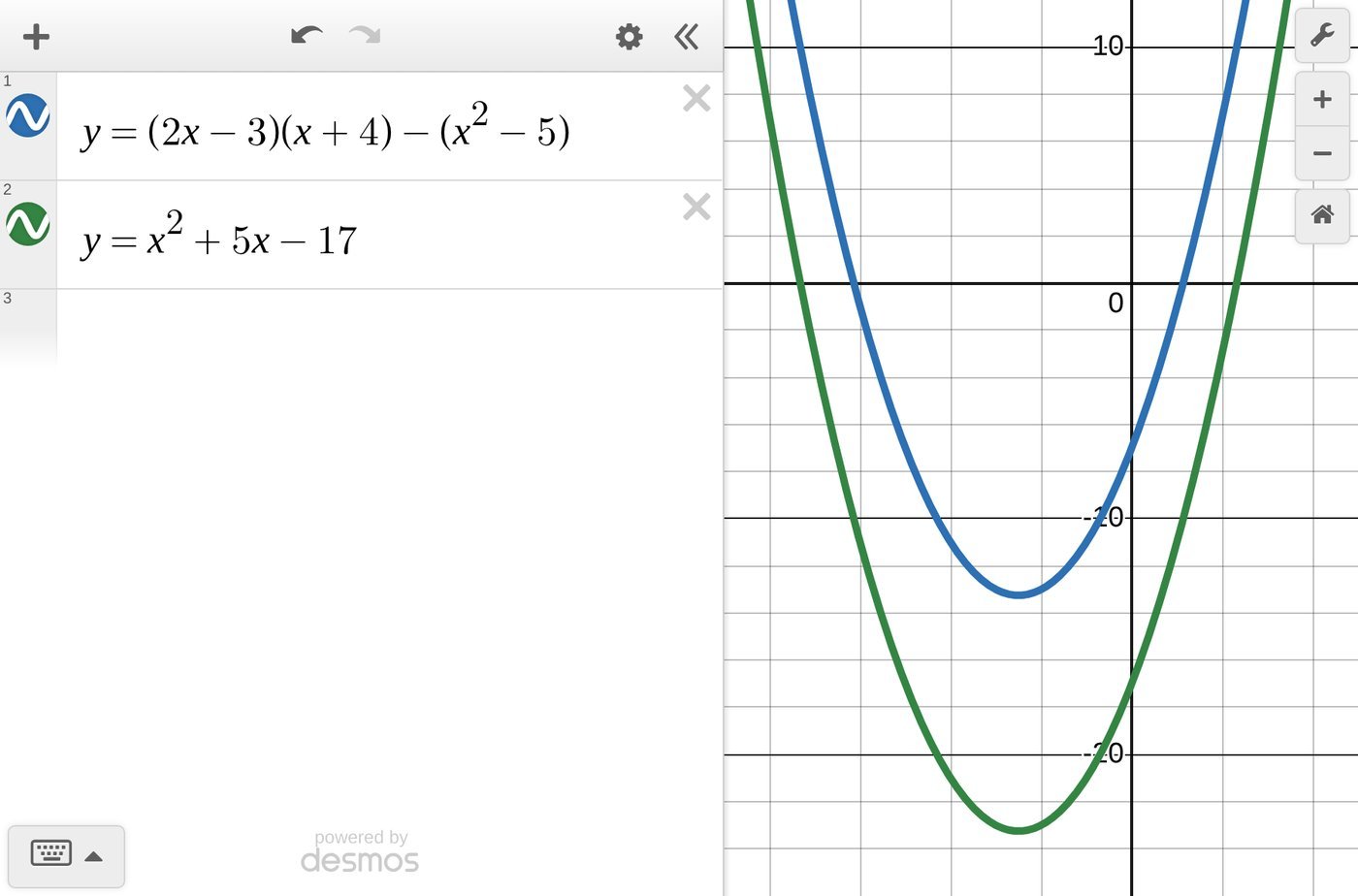
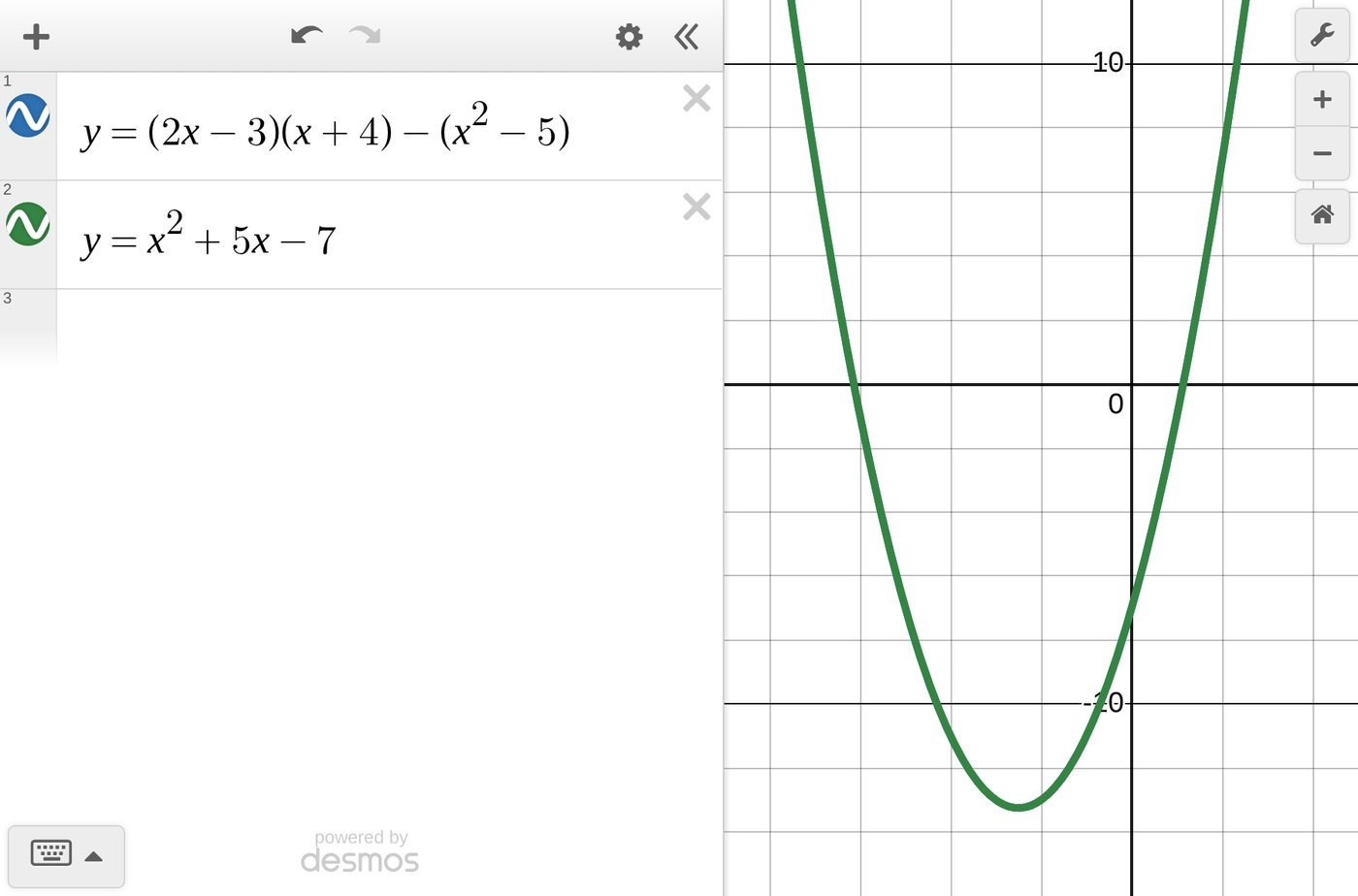
With choice B typed in, there are two parabolas. With choice A there is one. The answer is choice A.
Choice B comes from a sign slip: subtracting (x2 − 5) and getting −5 at the end where it should be +5. It is the slip the question is built around, and the graph catches it without you doing any algebra.
How can you be sure two graphs are really the same?
Two different curves can look the same in a small window. For a check that leaves no doubt, subtract the choice from the original in one line.
y = (2x-3)(x+4) - (x^2-5) - (x^2+5x-7)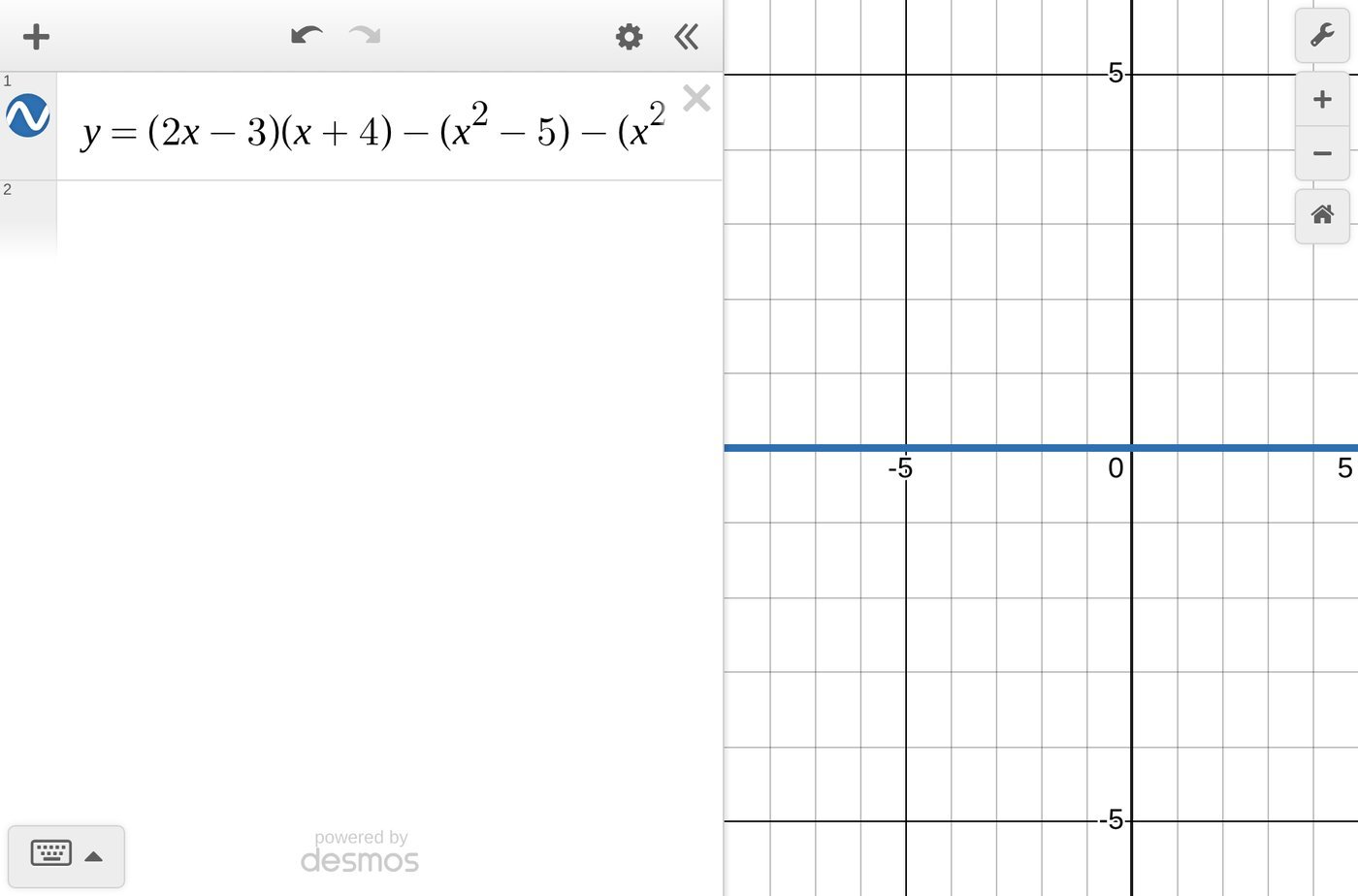
If the two are equivalent, the difference is 0 for every x, and Desmos draws a flat line along the x-axis. Anything else, a sloped line or a curve, means they are different.
Does it work with fractions?
Which expression is equivalent to 1/(x + 2) + 1/(x − 2), where x > 2?
- A2/(x2 − 4)
- B2x/(x2 − 4)
- C1/x
- D2/(2x)
Type y = 1/(x+2) + 1/(x-2). Desmos turns each slash into a stacked fraction as you type. Then try the choices. Choice B lands on top of the original. The answer is choice B.
Use brackets around every numerator and denominator that has more than one term. 1/x+2 means 1/x plus 2, which is a different expression.
Where do students slip?
1. Brackets
Nearly every wrong result with this method is a typing error, not a maths error. After typing, compare what Desmos displays with the question, symbol by symbol.
2. The expression uses another letter
If the question is in terms of t or a, type x in its place everywhere, in the original and in every choice.
3. Two variables
An expression such as 3x2y − 6xy has two letters and cannot be graphed this way. For those, pick simple numbers for both letters, such as x = 2 and y = 3, and compare the values.
4. Trusting a small window
If two curves agree near the middle and you are unsure, zoom out once, or use the subtraction check.
When is this the wrong tool?
- When the expression is short. Distributing 3(x + 4) by hand takes three seconds.
- When the question asks for a constant inside an equivalent form, such as "(ax + 3)2 = 16x2 + bx + 9, what is b". You can still do it in Desmos, but it needs a different move.
- When there are two variables, as above.
Three questions to try
Which expression is equivalent to (3x + 2)2 − (x − 1)(x + 1)?
- A8x2 + 12x + 5
- B8x2 + 12x + 3
- C8x2 + 6x + 5
- D10x2 + 12x + 5
Show the answer
Choice A. It is the only one that lands on the original. Choice B is the sign slip on the −(−1).
Which expression is equivalent to 2/(x − 1) − 1/(x + 1), where x > 1?
- A1/(x2 − 1)
- B(x + 1)/(x2 − 1)
- C(x + 3)/(x2 − 1)
- D(3x + 1)/(x2 − 1)
Show the answer
Choice C. Type the original with brackets: 2/(x-1) - 1/(x+1).
Which expression is equivalent to 4x2 − 12x + 9?
- A(2x − 3)2
- B(2x + 3)2
- C(4x − 3)2
- D(2x − 3)(2x + 3)
Show the answer
Choice A. Choice D gives 4x2 − 9, which has the same shape but sits lower.
Questions students ask us
How do I know two expressions are equivalent in Desmos?
Graph both as y = lines. If they are equivalent you see a single curve, because one graph lies exactly on top of the other.
How do I hide a graph in Desmos?
Click the coloured circle to the left of the line. Click it again to show the graph.
Can I compare values in place of graphs?
Yes. Type each expression with a number in place of x, such as 2, and compare the results. If the values differ, the expressions are not equivalent. Graphing checks every value of x at once, so it is the safer test.
Does this work for expressions with exponents and roots?
Yes. Type ^ for a power and sqrt for a square root. Desmos graphs any expression in x.
What if none of the choices overlap?
Then there is a typing mistake in the original. Check the brackets and the minus signs first.
Read next
- How to solve an equation in Desmos on the SAT
- How to find the mean and median in Desmos on the SAT
- The hardest SAT Math question types in Module 2
About the authorRonak teaches SAT Math at Stuck in SAT. He has a Master's in Applied Mathematics and has taught for 8+ years, most of it one to one. He wrote the SAT Desmos Bible. Our story
We wrote every question on this page ourselves. The screenshots are from the Desmos graphing calculator. Found a mistake? Tell us and we will fix it.