
How to solve a system of equations in Desmos on the SAT
 By Ronak, SAT Math, Stuck in SAT
· 7 minute read
Type the two equations into Desmos exactly as they are written, one per line. Click the point where the two graphs cross. Desmos shows its coordinates, and that point is the solution (x, y). If the graphs never cross there is no solution, and if they lie on top of each other there are infinitely many.
How do you solve a system in Desmos, step by step?
- Type the first equation. You do not need to rearrange it. Desmos accepts
3x + 2y = 16as it is. - Type the second equation on the next line. It gets a different colour.
- Click the crossing point. Click one of the graphs first if no grey dot is showing. Desmos marks the crossing with a dot and shows the coordinates when you click it.
- Answer what the question asks. The SAT rarely asks for the point itself. It asks for x, or y, or x + y. Read the last line of the question again before you answer.
Two linear equations
If (x, y) is the solution to the given system of equations, what is the value of x + y?
3x + 2y = 16
5x − 4y = −10
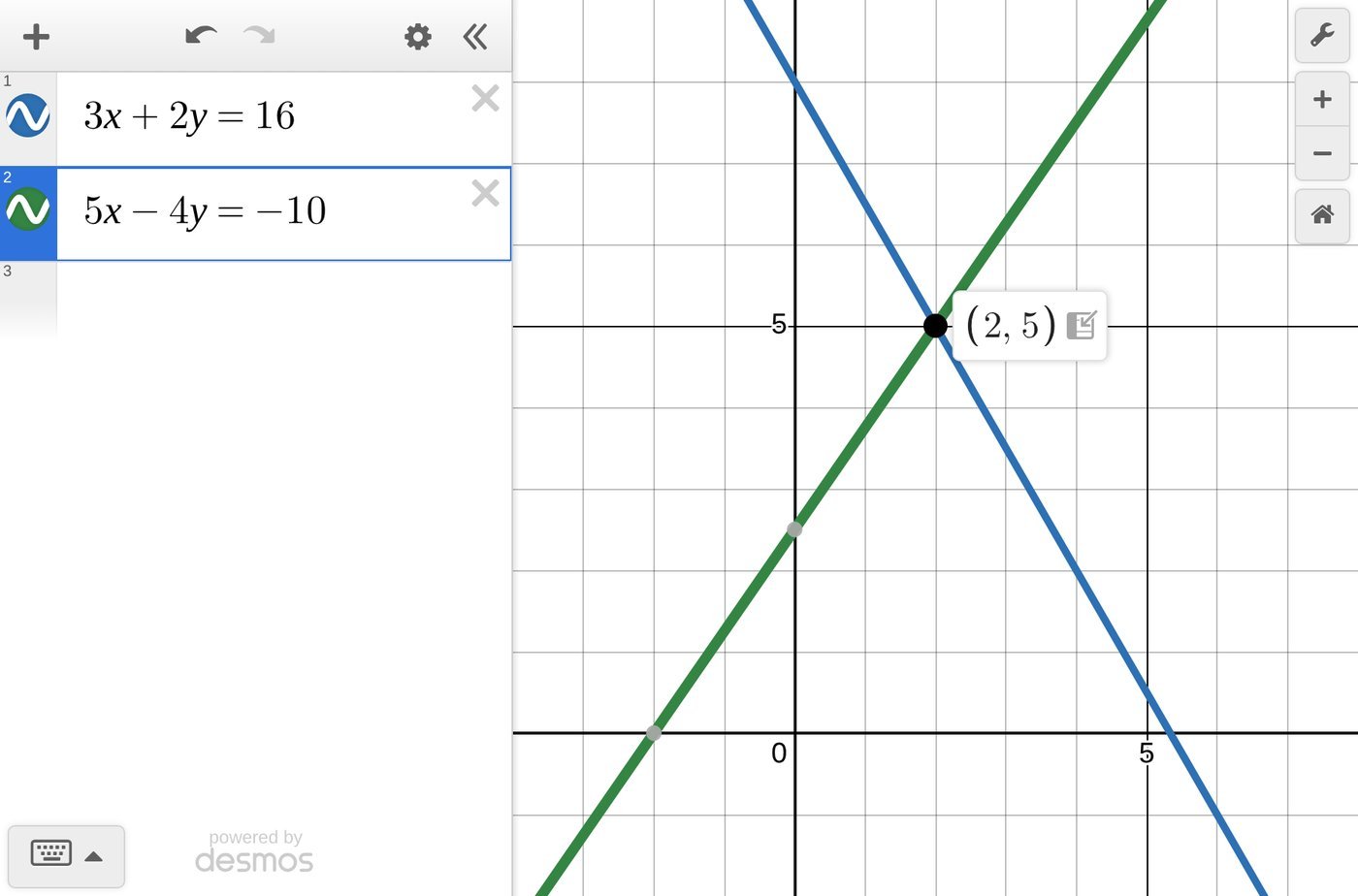
The point is (2, 5), so x = 2 and y = 5. The question asks for x + y, which is 7.
By hand this system needs you to multiply the first equation by 2 and add. That is about a minute and two chances for a sign slip. In Desmos it is two lines of typing.
A line and a parabola
This is where Desmos saves the most time, because the algebra version needs substitution and then factoring.
The given system of equations has two solutions. What is the sum of the x-coordinates of the two solutions?
y = x2 − 4x + 1
y = 2x − 7
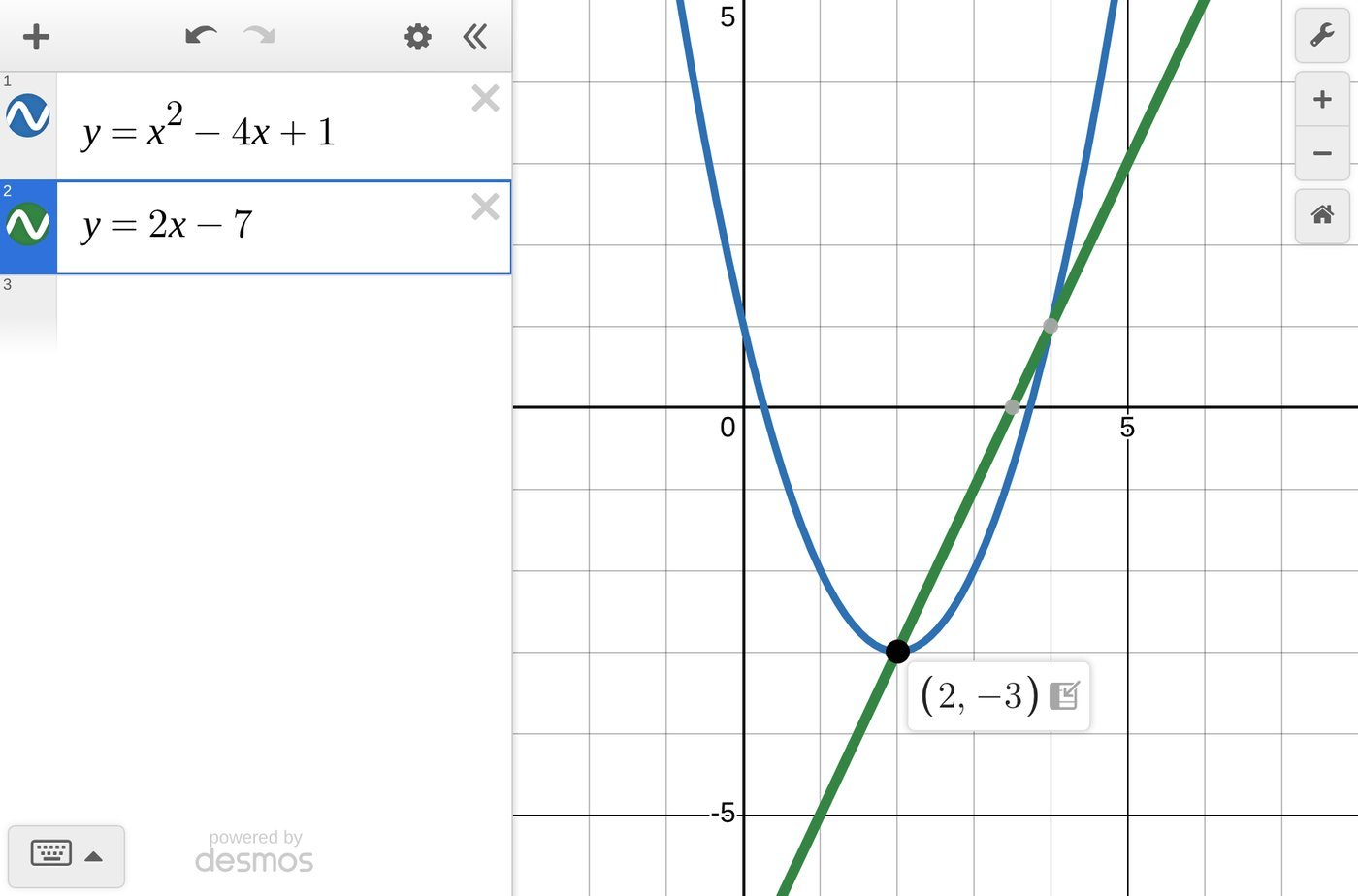
The graphs cross at (2, −3) and (4, 1). The x-coordinates are 2 and 4, and their sum is 6.
Click every grey dot before you answer. Students who click one and move on answer 2, or −3, and both are wrong.
What do "no solution" and "infinitely many" look like?
How many solutions does the given system of equations have?
2x − 6y = 5
x − 3y = 4
- AZero
- BExactly one
- CExactly two
- DInfinitely many
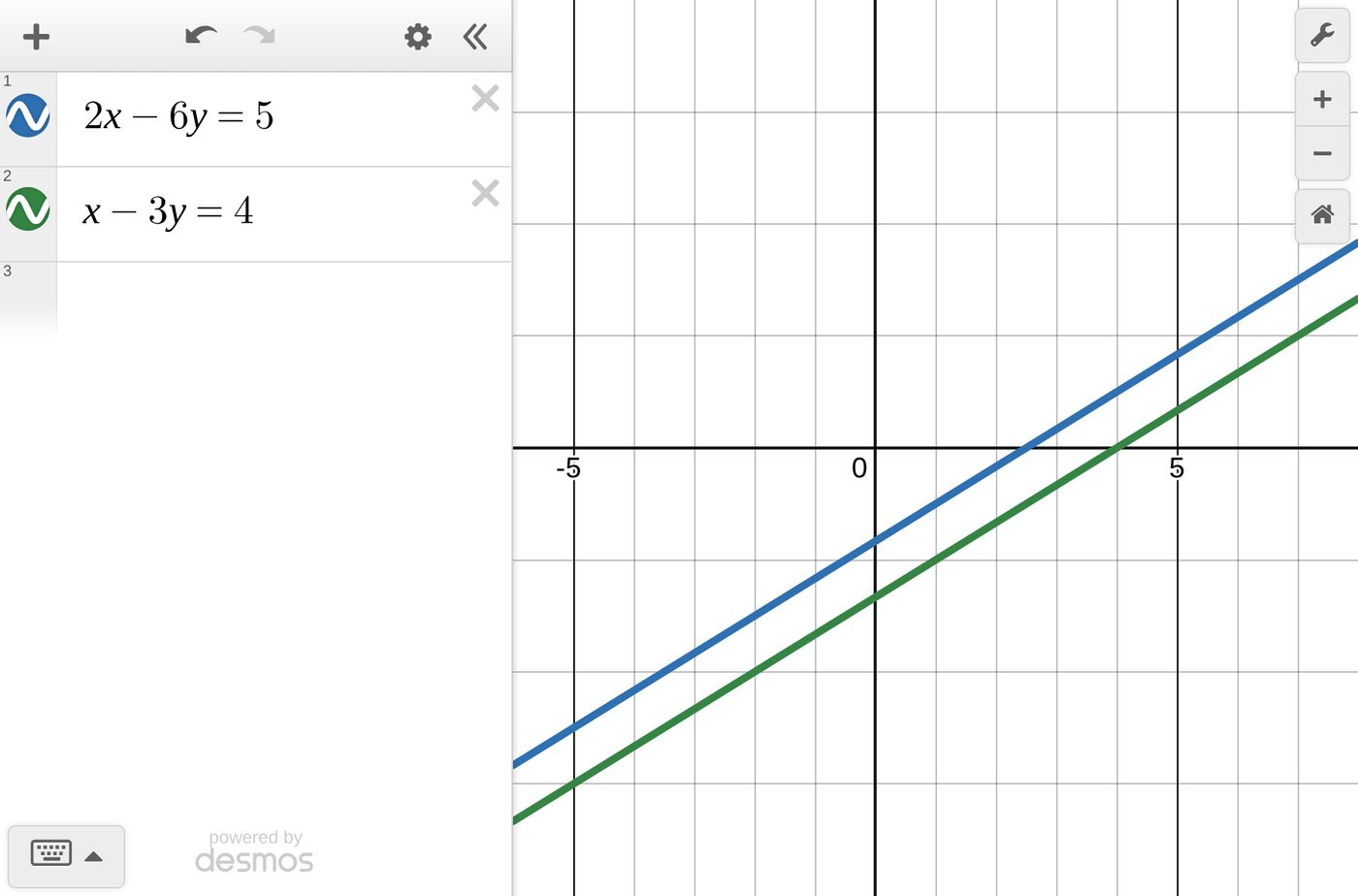
The lines are parallel, so there is no point on both. The answer is choice A.
If you type two equations and see only one line, they are the same line. Every point on it is a solution, so there are infinitely many. You can check by clicking the coloured circle next to one equation to hide it: the line stays.
Where do students slip?
1. The crossing is off the screen
Desmos opens showing −10 to 10. If the lines look like they will meet outside that, zoom out with the minus button, or drag the graph.
2. The equations use other letters
Desmos graphs x and y. If the question uses a and b, or p and q, type x for the first letter and y for the second, everywhere. Then remember which was which when you answer.
3. Reading a long decimal as the answer
If Desmos shows something like (2.333, 1.667), the exact answer is a fraction. 2.333 is 7/3. To check a choice, type it in a new line, for example 7/3, and compare the decimals.
4. Answering x when the question asks for y
This is the most common slip on system questions, with or without Desmos. The point gives you both values, so take the one the question names.
When is Desmos the wrong tool for a system?
- When the question is a word problem and the hard part is writing the equations. Desmos only helps after the equations exist.
- When the system has an unknown constant, such as "for what value of k does the system have no solution". That needs a slider, which is a separate move.
- When one glance solves it. If the equations are x + y = 10 and x − y = 2, adding them is faster than typing them.
Three questions to try
If (x, y) is the solution to the given system of equations, what is the value of y?
4x − y = 9
2x + 3y = 1
Show the answer
−1. The lines cross at (2, −1).
One solution to the given system of equations is (a, −4). What is the value of a?
y = x2 + 2x − 3
y = −x − 5
Show the answer
−1. The graphs cross at (−1, −4) and (−2, −3). The point with y = −4 has x = −1.
How many solutions does the given system of equations have?
3x + 6y = 12
x + 2y = 4
- AZero
- BExactly one
- CExactly two
- DInfinitely many
Show the answer
Choice D. Desmos draws one line, because the first equation is the second multiplied by 3. Every point on the line is a solution.
Questions students ask us
Do I have to write the equations as y = ... first?
No. Desmos graphs an equation with x and y on either side, so you can type 3x + 2y = 16 exactly as it appears.
How do I see the intersection point in Desmos?
Click one of the graphs. Grey dots appear at the crossing points and intercepts. Click a grey dot and Desmos shows its coordinates.
Does this work for three equations?
SAT systems almost always have two equations in x and y, and this method covers them. If a third equation appears, type it as a third line and look for the point where all three graphs meet.
What if the answer choices are fractions and Desmos shows decimals?
Type each fraction choice in a new line, such as 7/3. Desmos shows its decimal value and you match it to the coordinate.
Is it faster than elimination?
For two clean linear equations the two are close. For a line with a parabola or a circle, or equations with awkward numbers, Desmos is clearly faster and avoids sign slips.
Read next
- How to use a Desmos slider on the SAT
- How to find the vertex, maximum or minimum in Desmos on the SAT
- How to check equivalent expressions in Desmos on the SAT
About the authorRonak teaches SAT Math at Stuck in SAT. He has a Master's in Applied Mathematics and has taught for 8+ years, most of it one to one. He wrote the SAT Desmos Bible. Our story
We wrote every question on this page ourselves. The screenshots are from the Desmos graphing calculator. Found a mistake? Tell us and we will fix it.